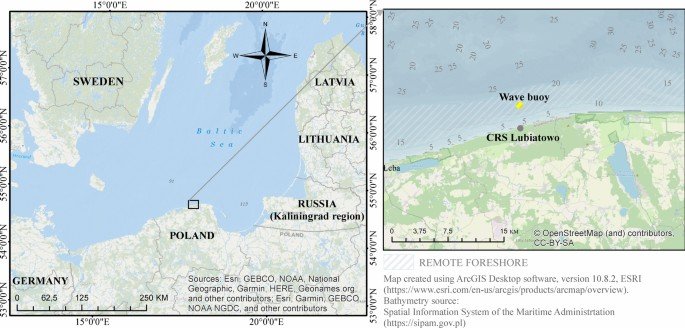
A recent study spanning 14 months has provided detailed measurements of wave, current, and wind dynamics in the remote foreshore of the south Baltic Sea. Conducted by the Coastal Research Station in Lubiatowo, Poland, the research aims to enhance understanding of the hydro-meteorological processes that shape this region, especially as it becomes a focal point for renewable energy initiatives.
In non-tidal seas, the behavior of waves and currents is complex. While the nearshore surf zone experiences significant wave energy dissipation, deeper areas are primarily influenced by wind-induced currents. The study area extends up to 20 meters in depth, where interactions between storm waves and currents can cause sediment transport even beyond the so-called depth of closure, which is the point where wave-induced bed changes are minimal.
The research involved long-term monitoring using Directional Waverider buoys, deployed at depths of 18 meters, approximately 2.8 kilometers offshore. These buoys recorded data from November 2022 until January 2024, allowing for simultaneous collection of wave heights, periods, and wind parameters. The data revealed that the average wave height ranged between 0.5 and 1.5 meters, with extreme conditions recorded during storms, including a notable maximum wave height of 7.80 meters during Hurricane Xavier in December 2013.
The study highlighted the importance of understanding wave and wind dynamics for the region’s energy transition. Close to the research site, Poland’s first offshore wind farm—Baltic Power—is under construction, expected to generate around 1.14 gigawatts of electricity by 2026. This facility aims to supply power to approximately 1.5 million households. Additionally, preparatory work is advancing for the country’s first coastal nuclear power plant nearby, further emphasizing the need for precise modeling of local hydrodynamic processes.
Measurements also indicated that the most intense waves predominantly came from the west-northwest, while wind direction exhibited a similar pattern. The study recorded maximum wind speeds of 19.93 m/s and maximum superficial current speeds of 1.09 m/s during storms. These findings underscore the interconnectedness of wind and wave dynamics, showing that strong winds contribute to substantial wave generation in the area.
The research utilized advanced equipment, including an acoustic current meter combined with the Directional Waverider buoy. This setup allowed for high-frequency data collection—every 10 minutes—capturing real-time changes in wind and wave behavior and providing a robust dataset for analyzing hydrodynamic phenomena.
The study also applied statistical methods to evaluate the relationships between wind, waves, and currents. Results indicated that strong wind events directly correlated with increased current speeds, reinforcing the hypothesis that wind is a primary driver of current dynamics in the Baltic Sea.
In a region poised for significant energy development, this research lays a foundation for future studies and modeling, which will be essential for optimizing the design and operation of renewable energy facilities. With both offshore wind and nuclear power projects on the horizon, understanding the local hydro-meteorological conditions will be critical for ensuring the efficacy and safety of these energy systems.