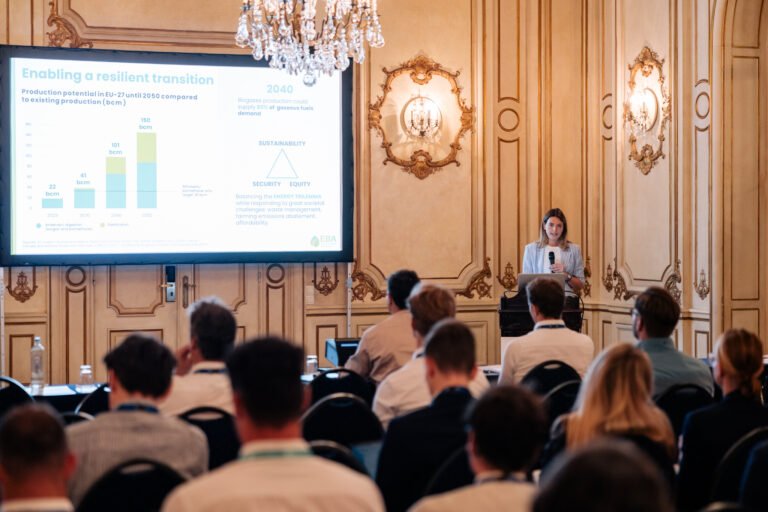
The 2025 International Biogas Congress & Expo took place from June 24-25 in Brussels, Belgium, attracting over 350 professionals from the bioenergy sector, including producers, suppliers, regulators, and technology developers. This event emphasized the importance of investment in biogas for achieving decarbonization, energy security, and net-zero targets.
Key discussions focused on the European Union’s Fit-for-55 package and the REPower plan, exploring how these initiatives can support the biogas sector. High-profile speakers covered topics such as updates on the biomethane market, policy changes, and technological innovations. Notably, projections indicate that private investment in the European biomethane sector could reach €25 billion by 2030.
Networking sessions and exhibition booths allowed attendees to connect and share knowledge, bridging the gap between scientific research and practical applications. The Congress was co-located with the Sustainable Aviation Fuel Summit and the Biofuels International Conference & Expo, fostering collaboration among diverse stakeholders.
**Policy Momentum and Market Growth** Grazia Vascello, a policy officer at the European Biogas Association (EBA), detailed the evolving policies impacting Europe’s biogas and biomethane markets. Representing over 50 national associations and research bodies, the EBA works to promote bioenergy interests within EU institutions. Vascello highlighted four main policy priorities: 1. The European Commission is focusing on energy security and competitiveness, with biomethane positioned as a key alternative to Russian gas. 2. RePowerEU and the revised Renewable Energy Directive (RED III) are accelerating legislative measures supporting renewable gases, including biogas. 3. The 2040 climate targets will influence emissions reductions and updates to EU energy policies. 4. The EU Forest Strategy and emerging carbon capture techniques will also play a role in biogas development.
In 2023, biomethane production in the EU reached approximately 5 billion cubic meters, an 80% increase from the previous year, with major contributions from France, Denmark, and the UK. The EU now has over 1,300 operational biogas plants, with 85% connected to the grid. New facilities are increasingly utilizing sustainable feedstocks like agricultural residues and waste instead of energy crops. Investment in the sector was robust in 2023, totaling €2.7 billion, with 150 new plants expected to come online within five years, particularly in Ireland, Spain, Portugal, and Poland.
**Biogas Development in the Arctic** Simon Ford, director of technical development at Rå Biopark, discussed the challenges and successes of establishing biogas infrastructure in Northern Norway. Leading a multi-municipal initiative in Troms and Finnmark, Ford described how cooperation among public-sector waste operators has turned organic waste into a reliable renewable energy source. Previously, the region lacked the infrastructure for viable biogas production. By consolidating 15,000 tonnes of household organic waste and inputs from breweries and agriculture, the initiative is now focusing on biomethane for transport, particularly as high diesel prices make renewable gas an attractive option.
The Norwegian government is co-financing the construction of new fueling stations to support heavy goods vehicle adoption. Solutions for digestate management, often challenging in remote areas, include evaporation towers and wet pyrolysis, which produce transportable outputs like ammonia.
**Biomethane Trade Challenges in Europe** Lucas Oliveira from Engie’s Global Energy Management biomethane trading desk outlined the complexities of scaling biomethane trade in Europe. Engie aims for 10 TWh of biomethane production by 2030, supported by a €3 billion investment plan. The company manages over 500 contracts with small producers in France and operates across nine countries, facing logistical challenges related to guarantees of origin and proof of sustainability.
The fragmented nature of Europe’s biomethane market complicates cross-border trading. Differences in registry systems, accepted feedstocks, and certification schemes create administrative burdens. Engie has developed a digital tool called METAPoS to manage these challenges by tracking deliveries, ensuring compliance, and generating reports.
Oliveira emphasized the need for regulatory harmonization at the EU level to reduce administrative tasks and improve market liquidity. He mentioned that pending legislation could help standardize data flows.
**Biomethane Sourcing in the Nordics** Ari Suomilammi from Gasum provided insights into biomethane sourcing and trading in Finland, Sweden, and Norway. Gasum operates a network of biogas plants and over 100 gas filling stations, responding to rising demand for biomethane, particularly in transportation.
With long-term sourcing contracts, Gasum blends biomethane with conventional natural gas in a “bio premium” model. Suomilammi pointed out the regulatory complexities and risks associated with varying biomethane premiums across different countries. Gasum manages these risks through fixed-price contracts and strategic controls over open positions.
**Certification and Carbon Intensity** Tim Hamers from the European Renewable Gas Registry discussed the challenges of certifying biomethane and bio-CO2. The current fragmented certification landscape complicates cross-border trade and risks double counting. Hamers advocated for a unified certification system to simplify processes and enhance market transparency.
Roland Kok from Route to Market noted that many biogas producers miss optimization opportunities that could improve carbon intensity. Strategies include using accurately measured feedstock values and implementing practices that lower emissions during biogas processing. Kok emphasized the importance of managing carbon capture credits effectively to avoid double counting.
**Private Equity in Biogas** Khash Mohajerani from OrbeNovo Capital addressed the growing interest of private equity in the biogas sector. With an £80 million investment in EAG Bio Energy, he highlighted biogas’s potential as a clean energy source that complements wind and solar energy. The sector is transitioning from small, fragmented operations to larger, scalable platforms that can deliver consistent returns. However, Mohajerani cautioned that the complexities of feedstock contracts and regulatory environments present challenges for investors.
The 2025 International Biogas Congress & Expo showcased the dynamic landscape of the biogas sector, underscoring the importance of collaboration, investment, and innovation for its future growth.