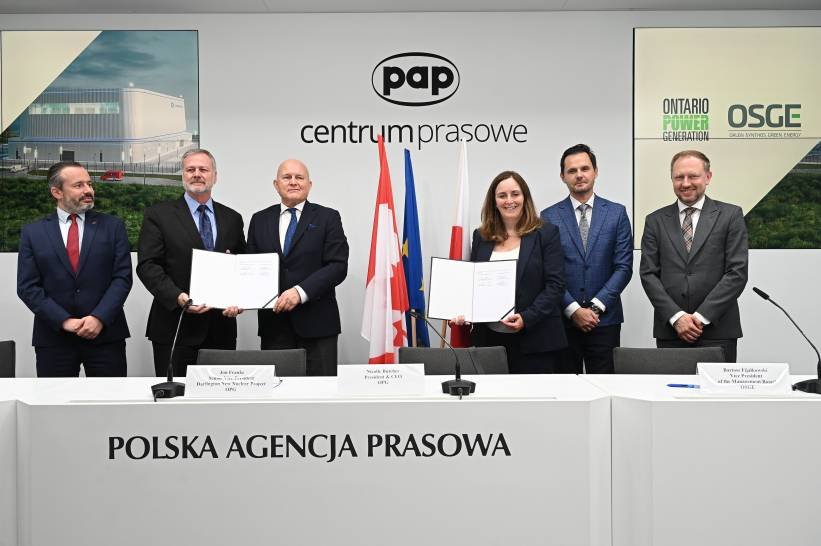
Orlen Synthos Green Energy (OSGE) and Ontario Power Generation (OPG) signed a letter of intent on July 21, 2025, to collaborate on the construction of small modular reactors (SMRs) in Poland. This partnership allows OPG to provide a range of essential services for the implementation and safe operation of BWRX-300 SMRs in the country.
Bartosz Fijałkowski, OSGE’s Deputy Head, announced that further agreements between OSGE’s stakeholders are forthcoming. He emphasized the importance of this collaboration, particularly as Poland plans to develop a large nuclear power plant in the Lubiatowo-Kopalino area. However, Fijałkowski noted that the country’s ambitions extend beyond this facility, focusing on advancing small-scale nuclear energy.
Wojciech Wrochna, the government representative for strategic energy infrastructure, confirmed ongoing efforts at both the EU and national levels to establish frameworks for nuclear energy development. The collaboration with Canada, which has gained momentum since April 2025, provides invaluable knowledge to prevent repeating mistakes made in previous projects.
Fijałkowski highlighted that the construction of an SMR should not exceed 36 months. He anticipates securing approval for the construction of the nuclear portion by 2028. OSGE aims to have two operational SMRs in Włocławek by 2035, supplying both electricity and heat to local facilities. Preliminary work has been ongoing for 18 months at Włocławek and Stawy Manowskie, with further seismic analyses being conducted.
On January 7, 2023, Canadian Prime Minister Justin Trudeau and Polish Prime Minister Donald Tusk signed an agreement to facilitate the peaceful use of nuclear energy, enabling technology transfer from Canada to Poland. This Nuclear Cooperation Agreement (NCA) allows collaboration between the nuclear industries of both nations.
On May 8, 2023, Ontario’s provincial government made a financial commitment to build the first BWRX-300 reactor at the Darlington nuclear plant. OPG, which owns and operates 75 power plants, including two nuclear facilities, is also involved in energy storage and electric vehicle charging initiatives. The overall Canadian project includes four reactors, with the first unit expected to cost approximately CAD 6.1 billion and infrastructure costs estimated at CAD 1.6 billion. The total investment for this project may reach CAD 20.9 billion.
In Poland, OSGE plans to construct a fleet of GE-Hitachi BWRX-300 reactors at various sites, including Włocławek and Stawy Monowskie. These reactors, part of the boiling water reactor (BWR) family, have a capacity of 300 MWe and are classified as small modular reactors.
Fijałkowski mentioned ongoing discussions regarding a new agreement that will outline project timelines, technology access, and OSGE’s operational framework. He indicated that commercial terms have been established, and a final agreement could be reached within a few weeks.
In December 2023, Poland’s Ministry of Climate and Environment issued six key decisions regarding the construction of six BWRX-300 nuclear facilities by OSGE. However, the internal security agency’s opinion on these projects was negative, prompting further scrutiny of OSGE’s structure and decision-making processes. This audit is aimed at ensuring safe management of these investments, with a focus on the entities responsible rather than the technology itself.
The ongoing collaboration between Poland and Canada signifies a strategic approach to nuclear energy development, aiming to introduce advanced technology while addressing safety and regulatory needs.