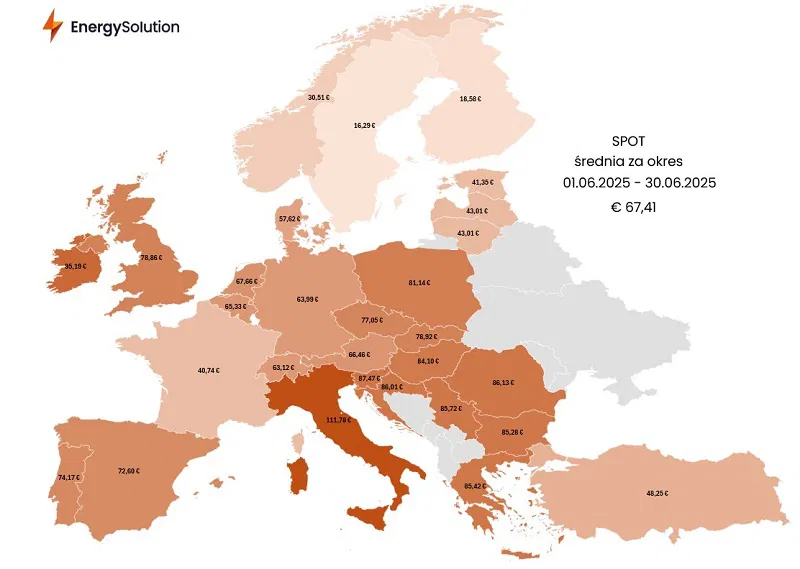
In June 2025, Poland experienced its lowest spot market energy prices since the introduction of balancing market reforms, with prices dropping by over €13/MWh to €81.14/MWh. This significant decrease occurred despite rising wholesale energy prices across Europe, including Turkey, where average prices rose by 1% compared to May.
Energy experts Krzysztof Mazurski and Wojciech Listoś from Energy Solution analyzed the trends and reported that while the European market for next-day deliveries saw increases, Poland recorded a historic decline. The average European spot price reached €67.41/MWh in June, indicating Poland’s prices are still high relative to the continental average.
The drop in Poland’s energy costs can be attributed to two main factors: increased wind generation and reduced demand from the National Power System (KSE). Wind power generation in June surged to an average of 2.9 GW, a 93% increase from June 2024 and a 123% increase from June 2023. This month marked the second windiest of the year, only behind January, which saw wind generation exceed 4 GW.
In addition, the KSE’s demand fell to 16.55 GW, marking a 2.1% decrease month-over-month and a 6.7% drop year-over-year. June was also notable for its energy generation structure, with solar and wind sources contributing a combined 39% of total electricity production.
On the futures market, the BASE_Y contract for 2026 saw minimal increases of about 1-1.5%, with Polish contracts rising by €1.35/MWh to €98.40/MWh. This marks the third consecutive month that prices remained below €100/MWh, a positive development compared to the eight other European countries that exceeded this threshold, including Romania (€113.48/MWh), Hungary (€112.04/MWh), and Bulgaria (€112.01/MWh).
Energy Solution specializes in advisory services related to electricity and natural gas, and has been involved in projects focused on high-efficiency co-generation and energy audits since 2018. Their insights into the Polish energy market reflect ongoing shifts toward renewable generation and changing demand patterns, which are crucial for stakeholders in the energy sector.